
Have you ever felt that your brain temporarily shuts off in an important lecture? Maybe you’re struggling to focus or keep rereading the same paragraph.
If yes, you might be experiencing “zoning out”.
Zoning out is basically a symptom of dissociation. It’s a coping mechanism that automatically starts when an individual feels bored, tired, distracted, stressed, or anxious. However, it’s completely normal to zone out sometimes, but if it’s affecting everyday life activities, it can be a serious mental health disorder.
If you feel like you frequently zone out during important tasks, don’t worry, you are not alone. It often occurs because of underlying mental conditions such as depression, ADHD, or PTSD.
What is Zone Out?
It’s a natural experience that occurs in different situations and different age groups. It can also be known by the term daydreaming or mind wandering. It’s a cognitive phenomenon that makes one take a temporary escape from the surroundings, as it leads the focus in the other direction. People who are experiencing zoning out, lost in thinking, and remain unaware of their environment.
However, it’s a very common experience, as millions of people around the world struggle with zoning out because of mental health disorders . It happens when the brain switches into autopilot mode, as it’s a fundamental function of our psychology. Zoning out offers a mental break from external pressures or stresses, allowing the mind to recharge. Yet, there are some other consequences as well; as this condition can lead to errors during critical tasks, such as work performance, relationships, and eventually lead to misunderstandings.
Examples
To better understand zone out, here are some of the real-life examples:
A child reading a book for an upcoming exam, trying to pay attention, but suddenly zones out and thinks about other unimportant things. Or when an individual has been staring at the TV but realizes they have no idea what’s been happening on the screen during the last few minutes.
What are the Symptoms of Zoning Out?
People experiencing this condition might drift into a short mental disconnect many times. There are no physical symptoms, but there are some of the common signs that may help in diagnosing the condition.
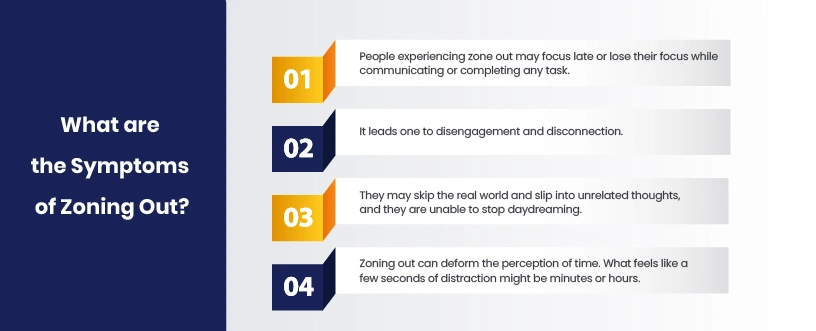
- People experiencing zone out may focus late or lose their focus while communicating or completing any task.
- It leads one to disengagement and disconnection.
- They may skip the real world and slip into unrelated thoughts, and they are unable to stop daydreaming.
- People in this state can deform the perception of time. What feels like a few seconds of distraction might be minutes or hours.
- It makes one less responsive to the things happening around them, such as not hearing someone call their name or missing important points in a meeting.
- appearing lost or preoccupied
- People who often zone out remain blank, which can be noticed by others as well
- It also leads to memory issues as they struggle to recall the previous details during that period.
The Brain’s Autopilot Mode
Getting zoned out often is a normal part of life. The human brain operates in a complex way through neural networks. The brain has an ability to enter into an “autopilot” or “default mode,” which is thought to be responsible for mind-wandering. These parts of the brain are automatically activated when someone’s thoughts are going away from their surroundings and affect their focus. This dysfunction of the brain can further lead to rumination. It is because people who are struggling with excessive stress or mental health disorders usually engage in common processes like daydreaming, introspection, and mind-wandering. However, the autopilot mode helps in performing routine tasks, as it allows people to complete repetitive or habitual tasks with minimal conscious effort.
Understanding the balance between the brain’s mode and conscious attention is essential for effective functioning. It is important to recognize that the brain is on autopilot to redirect the focus consciously to prevent zoning out.
What’s the Difference between Zoning Out & Dissociation?
Zoning out and dissociation are mildly common as both have similar experiences. People who are experiencing zoned out briefly focus; for example, if they are getting a lecture, they forget what the instructor is talking about. Or if they are driving, they forget the exit because they are thinking about something else.
Whereas dissociation is a more severe experience that impacts memory, consciousness, emotions, and perceptions. In this scenario, if a person forgets something, that can be paired with emotional numbness. They feel disconnected from the real world and feel like everything is different around them. Dissociation can be intense and mild, for example, while reading a book, they become so immersed in the book that they forget about the real world. They came out of that imaginary world after finishing the book.
However, when dissociation is severe, it makes one feel like they are different, even though they feel like their own body or feel spaced from their thoughts, feelings, or memories.
So, some individuals experience intense forms of dissociation, which require professional help, like dissociative amnesia, depersonalization/derealization disorder, or dissociative identity disorder.
What are the Causes of Zoning Out?
This question might haunt people many times. However, mental distraction or zoning out can have various causes. Here are some of the factors that may lead the brain to zone out.
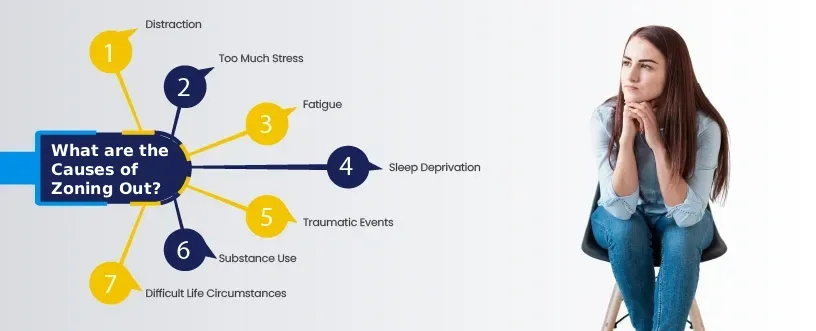
1. Distraction
Distraction can occur anytime while studying, watching a movie, or sitting out with friends. It is because people are not fully present at that moment. A neurotransmitter named acetylcholine is the main factor in the brain that handles attention and memory. A study in 2013 indicates that the brain’s default mode network (DMN) activates automatically during rest and internal thinking. It’s like the default mode, which allows the mind to wander away from the task at hand.
2. Too Much Stress
Excessive stress makes the mind turn towards a fight-or-flight response whenever danger is near. It’s because the brain shuts down when it wants to disconnect from overwhelming stress. The brain releases hormones like cortisol and adrenaline during stress, which makes one zone out during the present moment. However, a study by the National Institute of Medicine indicates that high levels of cortisol caused by extreme stress are associated with high dissociation in people who don’t have a history of mental disorders.
3. Fatigue
People who are excessively tired can zone out at any time. It is because fatigue makes one feel tired, and the brain may struggle to keep one alert, which makes one experience brain fog. However, brain fog is not a brain fog, but it may lead to several cognitive difficulties, which lead to forgetfulness and difficulty concentrating. It affects thinking, memory, and concentration.
4. Sleep Deprivation
People who don’t sleep properly might feel foggy or easily distracted. Although most people don’t feel like it’s a big deal, sleep deprivation can significantly impact mental functioning and make one more prone to zoning out. However, if you feel like you are frequently experiencing that condition or are unable to sleep, consider seeing a healthcare provider for treatment for insomnia.
5. Traumatic Events
Individuals who have witnessed traumas in their lives, specifically developed acute stress disorder or PTSD, can experience zoning out during triggering events. It is because people who have experienced PTSD have flashbacks, which are so intrusive that they make a person feel like they are experiencing that trauma again. It eventually leads them to zone out.
6. Substance Use
People who take substances excessively are more prone to zone out. As many substances induce a dissociative state, while others induce dissociation rapidly. These include regulated and illicit drugs such as alcohol, cannabis, Dextromethorphan, LSD, Mescaline (peyote), MDMA, Nitrous oxide, Psilocybin, and more.
7. Difficult Life Circumstances
Individuals who struggle with hardships and difficulties in life are also at risk of spacing out. It can be a hectic life schedule, such as having meetings, strict deadlines, and tasks that keep piling up. However, this overwhelming pace can cause one to zone out to let the brain take some rest.
Moreover, people who are physically restless for a long time can also zone out for a while to rest their minds.
Find the Right Provider for You
Learn more about our provider and discover personalized care for concerns such as zoning out, stress, anxiety, and emotional health.
✓ Experienced Mental Health Provider
✓ Therapy & Medication Management
✓ Telehealth & In-Person Appointments
✓ Most major insurances accepted
Expert consultation available · Flexible scheduling · Confidential care
Can Frequent Zoning Out Be a Sign of a Mental Health Condition?
Yes, frequent zoning out can be a sign of a mental health condition, if it is affecting everyday life activities. So, “When spacing out causes cognitive impairment, it means that one is not able to perform work and other tasks properly, which can be a sign of mental disorders.
Here are some mental health disorders associated with spacing out :
Zoning Out as a Sign of ADHD
It is one of the most common symptoms of attention-deficit hyperactivity disorder. It is because ADHD leads to memory impairment, which can affect attention and lead to distractibility. Also, an ADHD brain tends to hover away from a single thought, leading to complex emotions and ideas. It causes one to be inattentive, hyperactive, and impulsive. As per the research by the National Institute of Medicine, people with ADHD have difficulty paying attention and have an inability to read social cues, which makes them prone to zoning out. Also, there is an overlap between dissociation and ADHD symptoms, which include impaired memory and issues with concentration.
If you are zoning out frequently and notice other symptoms of ADHD, seek professional help for ADHD.
Spacing Out as a Sign of Depression
When people hear the word “depression,” they probably think of signs like sadness, fatigue, and feelings of worthlessness. It severely affects life and leads to cognitive impairment, which influences everyday life activities. It is because depression leads to trouble concentrating, understanding, and remembering; all these symptoms make one more vulnerable to increase the tendency to zone out. It is because a depressive episode makes a person forget what’s happening around and go deep into the thoughts where they spend hours ruminating, and in this way, they seclude themselves from the real world.
“Everything slows down, and you’re just checked out.
Hours and hours go by, and you don’t even realize time has passed.”
Zoning Out as a Sign of Anxiety Disorders
It is a common symptom of several anxiety disorders, it’s because anxiety leads to brain fog. Anxiety causes persistent fear that impairs daily functioning and causes problems concentrating, which eventually leads to spacing out. This ensues because fighting anxiety can be mentally exhausting and lead to cognitive fatigue, so the brain seeks space for this energy.
For example, high levels of anxiety may trigger depersonalization. In this, people may feel emotionally numb and detached from the real world.
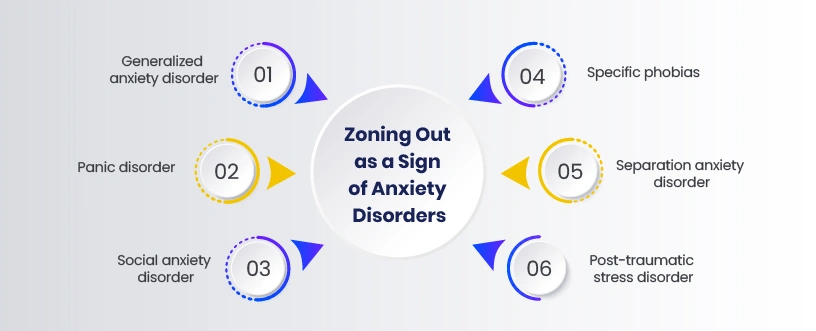
Anxiety disorders, which can often cause spacing out, include:
- Generalized anxiety disorder (GAD)
- Panic disorder
- Social anxiety disorder
- Specific phobias
- Separation anxiety disorder
- Post-traumatic stress disorder (PTSD)
Spacing Out a Sign Obsessive-Compulsive Disorder (OCD)
People can also zone out because of Obsessive-compulsive disorder (OCD). It is because the cycle of obsessions and compulsions makes one remain busy with the rituals. Obsessions cause intense fear and anxiety, and compulsions are the mental or physical actions performed to temporarily relieve distress. However, it’s a common way that may cause one to zone out. It is because the internal focus of thoughts can’t make one out of the present moment, leading to the experience of “spacing out.”
However, people with OCD can get triggered by some sort of fear, which makes them get stuck in these thoughts.
Treatments Approaches for Mental Disorders Associated with Zoning Out
If you feel like you are frequently zoning out because of a mental health condition. Seek help from a professional mental healthcare expert. Mental health disorders such as ADHD, anxiety, depression, or OCD are highly curable with the right combination of medications and therapies.
Only a certified professional can review your symptoms and provide an accurate diagnosis to get you started on the right treatment.
Here are some of the treatments that may help address recurring episodes of this condition:
Treating ADHD, anxiety disorders, depression, and OCD
Here are some of the common therapies that may help in treating these conditions.
Cognitive Behavioral Therapy (CBT)
CBT is considered to be one of the most effective treatment methods that may help in managing ADHD and other related conditions. In CBT, a mental health professional and a patient sit together and talk about their issues. A mental health professional helps change the negative thought patterns into positive ones. CBT helps with depression, ADHD, and anxiety symptoms.
Exposure and Response prevention (ERP)
Exposure and response prevention (ERP) is considered to be a first-line treatment for addressing OCD. ERP helps in breaking the cycle of obsessions and compulsions and also helps in reducing the anxiety and trauma, which often lead one to space out. Through ERP, a therapist gradually exposes the patient to their triggers and teaches them how to respond to those triggers. It helps in managing rumination and dissociation.
Acceptance and Commitment Therapy (ACT)
This therapeutic technique involves the acceptance of thoughts and viewing them as mental events rather than accurate truths. Through ACT, people find ways to see their thoughts as they are. So, it helps reduce the emotional grip of ruminative thoughts without the need to stop them.
Medications
Medications, along with therapies, also help in treating the condition in a more effective way. Some of the common medications include antidepressants, antipsychotics, and antianxiety medications.
Seek Professional Help at Orange Coast Psychiatry
If you feel like you are daydreaming or zone out during important discussions, it is impacting your everyday life. If you are wondering why this is happening, it can be a sign of a mental health disorder. Don’t worry, help is within reach now!
At Orange Coat Psychiatry, we have a specialized team of certified experts who provide exceptional treatments with an evidence-based approach. Our team is highly professional and offers tailored treatments as per your unique needs. We offer a safe space where you talk about your issues without fear of judgment. You can also get virtual treatments from the comfort of your home through our telepsychiatric treatments.
Book an appointment with a licensed medical provider today!