
Have you ever gotten stuck in the same negative thoughts over and over? If yes, you might have experienced rumination.
We all experience negative thoughts, but if we spend too much time on them, then it’s rumination. People often slip into this type of thinking where they want to solve a problem. The issue is that these negative thoughts don’t lead to solutions, instead it traps one in cycles of overthinking and self-criticism.
According to the National Institute of Medicine, rumination affects millions of people around the World. It is a cycle of repetitive negative thought patterns that severely impacts everyday life activities.
This pattern of thinking causes distress, and its consequences often lead to depression, anxiety, and other mental health conditions. Moreover, it’s not a normal or healthy way of solving problems. Instead, it drains the people internally.
Understanding this phenomenon is crucial for maintaining psychological well-being, early diagnosis, and effective treatments.
What is Rumination?
Rumination is the process by which the mind gets caught in repetitive processes of negative thinking, which negatively impacts mental health. It’s natural for humans to think about a problem again and again to find a solution. However, rumination increases the distress because magnifying negative emotions instead of creating actionable plans. It’s a type of false control over things in life that an individual has no control over. That’s a mental equivalent where an individual thinks that they are trying to heal, but gets more triggered.
“The word ‘ruminate’ comes from the Latin phrase for chewing cud. What cows do when they eat. Instead of finding the solution, it turns a thought over repeatedly, with usage dating back to the 1530s.”
People experiencing rumination don’t move forward, as it circles back, often because of guilt, fear, or self-doubt. Living with rumination is very challenging because it makes one remain stuck. It is associated with mood, anxiety, and depression because it reinforces the emotions it’s trying to fix. For example, you had a fight with a friend instead of thinking, “I’ll apologize to my friend tomorrow,” you remain stuck on the thought, “I’m a terrible person.”
However, if you feel like you are thinking about the event more and it’s going beyond your control, it isn’t a sign of a weak mind. At this stage, one should ask for help or seek professional support immediately.
Break Free from Overthinking Today
Constant overthinking and repetitive negative thoughts can feel emotionally exhausting. Our compassionate mental health professionals help you identify unhealthy thought patterns, manage anxiety, and develop healthier coping strategies for lasting emotional balance.
✓ Anxiety & fear management
✓ Therapy & medication services
✓ Telehealth & in-person care
✓ Most major insurances accepted
Expert consultation available · Flexible scheduling · Confidential care
Why Do We Ruminate?
People tend to start rumination to help themselves and to find solutions to their problems. They generally want to focus on positive thoughts. The issue arises when something frustrating or insulting happens, something difficult to accept, which they cannot let go of. That’s where one starts ruminating; it’s when something feels hard, and the mind ultimately thinks about it again and again. However, instead of providing clarity, it usually keeps one stuck in emotional overdrive.
Psychologically, rumination doesn’t provide any solutions; it’s just a coping strategy that backfires. People in this state may feel like they are in control, whereas they are just stuck ruminating on something, which just leads to more distress.
And the more you do it, the worse it gets. Each time you ruminate, the brain strengthens that loop, and over time, it becomes an automatic stress response. It’s harder to redirect your thoughts while experiencing rumination.
Signs of Rumination
Rumination is different and difficult to recognize; it often starts as “just trying to figure things out. Here are some of the signs that may help to recognize this condition.
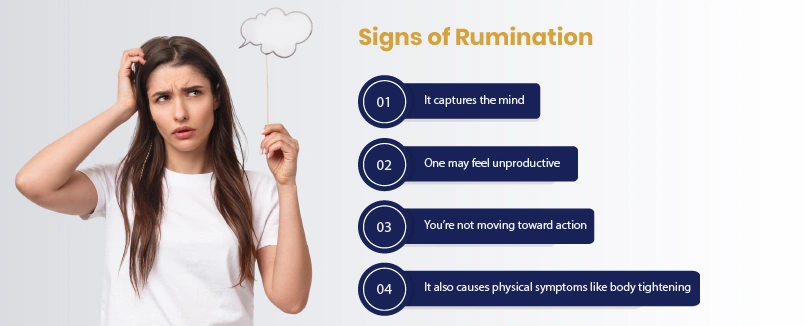
- People in this state replay the same scene or conversation in their heads
- These thoughts are intrusive and cannot be controlled by an individual
- It makes one feel emotionally drained and does not provide a clearer answer
- Physical symptoms like body tightening
- One may feel unproductive
Rumination can disturb everyday life, as most of the time, people ruminate during the night, which can seriously disrupt sleep. It is because at late hours there is no distraction, which can lead to replaying the thoughts of the day.
Moreover, if you feel like you are struggling with rumination and are having trouble managing it on your own, get help from a professional expert.
The Psychology Behind Rumination
Rumination leads the brain to remain hyper-focused on a specific thing, which causes overthinking that leads to worsening overall well-being.
“Rumination is an endless mental loop where there’s no escape.”
1. Cognitive Aspects
Rumination involves a keen focus on upsetting thoughts, emotions, and experiences, which leads to overthinking. This process severely impacts the brain, as it leads one away from reality and causes negative experiences and emotions. It affects the parts of the brain, such as the prefrontal cortex. The research by functional brain imaging studies has indicated that parts of the brain, which are in the default mode network (DMN), are deeply involved in ruminative processes. The DMN, a brain region that becomes active when an individual is not focused on external tasks and instead turns our attention inward.
2. Emotional Aspects
Anxiety and depression lead to negative emotions and thoughts, which are ultimately related to rumination. This emotional trap can prolong and intensify negative feelings and lead to mental health disorders, fostering a sense of hopelessness and helplessness.
What are the Types of Rumination?
There are two subtypes of rumination, which are known as reflective and brooding. Both types have different characteristics and consequences.
Reflective Rumination
Reflective involves purposely turning into thoughts to resolve the problem. It represents a more adaptive way of repetitive thinking, which helps in past events to gain insight and understanding. It involves actively thinking and leads to personal growth and problem resolution. People who have experienced traumas get help from the reflective subtype, as it helps in reducing the distress. This thinking pattern can help one process experiences and move forward.
Brooding Rumination
This type of rumination is more intense and complex as it focuses on negative emotions and events. It leads to negative thoughts, hopelessness, and self-criticism can lead to depression and anxiety. The passive thinking severely impacts decision-making and problem-solving. It involves self-questions like “Why did this happen to me and not others?”, which leads to severe issues. People in this state think that they are engaging, whereas they are just brooding.
However, these two types of rumination actually involve different brain mechanisms. Learning how to recognize and change thinking patterns can help shift toward more helpful thinking patterns.
How Rumination Affects the Body and Brain?
Rumination makes one feel irrational and leads to self-doubt. The effects extend beyond temporary distress, it affects mental and physical well-being.
Mental Health Effects
Individuals in this state feel like they are in danger, and remain in a fight or flight response. It severely damages self-esteem and leads to sadness, hopelessness, anger, and empathy. However which ultimately leads to mental health disorders like depression, OCD, eating disorders, and anxiety disorders. Also, intense ruminating thoughts disrupt sleep and cause exhaustion, which compounds mental health challenges. It affects social relationships as a constant internal focus reduces emotional availability.
Physical Health Effects
The effects of rumination aren’t just mental; they’re physical too. Extreme ruminating thoughts activate the body’s stress response repeatedly, which ultimately leads to raised cortisol levels, strained immunity, headaches, muscle tension, and rise inflammation. Therefore, individuals face higher heart issues, digestive risks, and have trouble sleeping. So, chronic rumination can trigger the body’s stress response repeatedly, which contributes to long-term health problems. It also affects how one may experience pain, as it makes one experience pain more intensely.
What Are the Mental Health Disorders Associated With Rumination?
Rumination is closely linked with several mental health conditions, which creates a relationship where each can influence the other. While persistent thoughts can also make the symptoms of mental conditions even more challenging to handle.
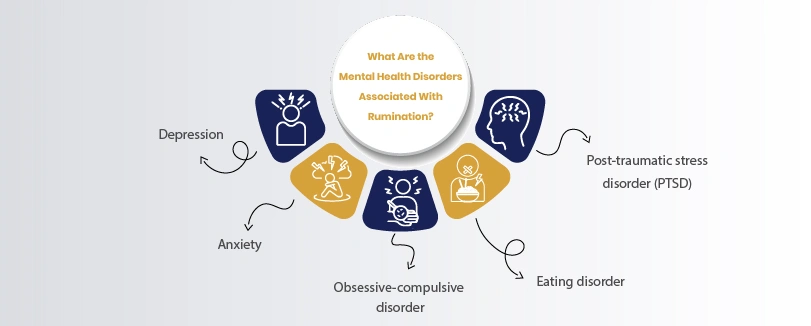
Here are some of the mental conditions that can cause rumination or be worsened by it:
1. Depression
“People who ruminate are more likely to develop depression compared to those who don’t.”
Depression can cause people to ruminate over difficult thoughts. As per the research, it is one of the contributors that increases the risk of developing rumination as it leads to depressed mood, leading to more feelings of depression. As there is a strong relationship between rumination and depression, people in this state remember more negative things about the past. They analyze situations in their current lives more negatively and become hopeless about the future. So, in depression, rumination typically leads to inadequacy, worthlessness, and hopelessness.
2. Anxiety
Anxiety causes excessive worry, fears, and rumination about various aspects of life. Rumination is considered to be a risk factor that contributes to the development of anxiety, as it convinces your brain that the danger is still present. People in this state usually worry about future events or destructive thinking about negative outcomes. The body stays tense, leading to racing thoughts, and rest feels impossible. It leads to generalized anxiety disorder, in which the inability to control repetitive thoughts is a main feature of the condition.
3. Obsessive-Compulsive Disorder
Obsessive-compulsive disorder (OCD) causes intrusive, obsessive thoughts that may lead to compulsive behaviors to relieve distress. OCD is directly linked with it, as rumination is a compulsion. Doing compulsions can reduce the symptoms caused by an unwanted, intrusive thought or obsession. Most people don’t realize how OCD can function in rumination, although it plays a role in maintaining OCD. Moreover, rumination is often misunderstood, as people wrongly think that compulsions need to be actions, such as washing hands or retracing steps.
4. Eating Disorder
Eating disorders can cause people to think more about food, dieting, and exercising. As per the National Institute of Medicine, individuals who exhibit eating disorders are more prone to experience ruminating thoughts. Negative thoughts tend to decrease mood and cause more negative body-related thoughts.
5. Post-traumatic stress disorder (PTSD)
People who have experienced traumatic memories and are struggling with PTSD often engage in ruminating about the distressing events. It is an intentional way to understand and process the trauma, although it increases the distress instead of resolving it.
What are the Causes of Rumination?
It is normal to think negatively about a stressful or upsetting experience. Most of the individuals ruminate because they think that thinking about a particular problem again and again might give them wisdom; instead, it only gets worse. People who have experienced traumas or are dealing with everyday stressors are more prone to develop rumination.
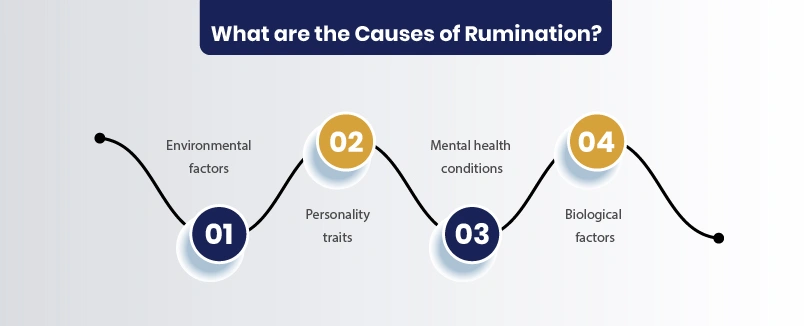
Some of the common factors may include:
Environmental Factors
Individuals who have experienced stressful life events, it can be a childhood trauma, a divorce, world-leading stress, or significant life changes. All these life events can lead one to ruminate, which increases the stress and leads to mental health disorders later in life. However, most of the time, people also ruminate after social interactions by thinking about the scenarios and conversations again, which can make one prone to developing social anxiety.
Personality Traits
Certain personality traits, such as perfectionism, neuroticism, and low self-esteem, increase vulnerability to this condition. Perfectionism leads to unrealistic measures that, when not met, can trigger extensive self-critical thinking. And people who have low self-esteem engage themselves in self-evaluation and rumination.
Mental Health Conditions
People who are already struggling with mental health disorders, such as depression, anxiety disorders, and high-stress environments, think negatively most of the time, which ultimately makes them prone to rumination.
Biological Factors
Genetics plays a major role in developing negative thinking or any other mental health disorders. As there are possible genetic factors and specific brain activation patterns that make one vulnerable to ruminating.
Understanding the causes and triggers helps individuals to get treatments earlier. As the excessive concern about relationships with others ultimately affects their relationships. Also, people who are highly sensitive to their emotional states or have difficulty tolerating uncertainty may also be more prone to ruminative thinking patterns.
How to Stop Ruminating Thoughts?
Rumination is difficult to manage, especially if one may not know that’s rumination. However, letting go of stress and anger can help reduce the distress. But if you feel like it’s unable to manage on its own, get professional help immediately. A mental health expert recommends treatments after ruling out the exact cause.
Professional Treatments
It is highly curable with the right combination of medications and psychotherapies. There are several effective approaches for addressing rumination. The effective treatments focus on changing the process of thinking rather than just the content of thought. So, here are some of the treatments that help:
Cognitive Behavioral Therapy (CBT): It is considered the most effective therapy option for people who are struggling with negative thoughts. CBT helps identify and change negative, unhelpful thoughts with more balanced and helpful ones. Rumination-Focused CBT (RF-CBT): It’s different from CBT but a subtype of CBT that is especially to target the mechanisms underlying rumination. In RFCBT, people realize the unhelpful thoughts and try to stop thinking about things that bother them. In this therapy, a mental health expert helps the individual to understand the triggers and consequences of =overthinking and replaces the unhelpful abstract.
Moreover, Mindfulness-Based Cognitive Therapy (MBCT) is a combination of cognitive behavioral therapy and mindfulness. It refers to being aware of the moment and involves focusing on the present moment thoughts. It is designed to help people detach from negative thought patterns by changing their attention. Additionally, Acceptance and Commitment Therapy (ACT), This therapeutic technique involves the acceptance of thoughts and viewing them as mental events rather than accurate truths. Through ACT, people find ways to see their thoughts as they are. So, it helps reduce the emotional grip of ruminative thoughts without the need to stop them.
Also, Exposure and Response Prevention (ERP): it is considered to be the “gold standard” treatment for rumination in the context of OCD. In exposure response therapy, the patient is exposed to triggering stimuli. The gradual exposure to different levels of stimuli makes the person habituated to the stimuli. Thus, the triggering element is not seen as a threat.
Moreover, a mental health expert also recommended medications along with therapies to get more effective outcomes. The medications include antipsychotics, antidepressants, and antianxiety medications.
The Road to Recovery
Recovering from rumination is a gradual process that requires patience and persistence. When a person ruminates, the same thoughts are constantly on their mind, making them grow ever bigger and taking them way out of proportion. So, if you or any of your loved ones are ruminating and don’t know where to get help. Don’t worry, help is within reach!
At Orange Coast Psychiatry, we have a certified team of experts who offer compassionate, evidence-based treatments. Whether you are dealing with depression, anxiety, OCD, or any other mental health disorder, we are here to help. We offer a safe and non-judgmental environment where you can share your heart without the fear of judgment. You can also get treatments virtually through our telepsychiatric treatments.
Book your initial consultation today!