
Experiencing ADHD does not always mean boundless energy or constant movement. Many people struggle silently with often-forgotten chores, missed deadlines, or a wandering mind that refuses to stay. This is called inattentive ADHD, a type that is about organizing things, focus, and follow-through, not hyperactivity.
ADHD challenges are frustrating and isolating. The right support will help you to learn different strategies to understand and handle it.
What is the Inattentive Type of ADHD?
Inattentive ADHD is one of the subtypes of ADHD. While the hyperactive-impulsive presentation of ADHD involves excessive activity and impulsive behaviour, individuals who have ADHD with an inattentive presentation find it hard to focus, pay attention, and complete assignments, instead of exhibiting hyperactive or impulsive tendencies. In other words, people who suffer from this type of ADHD are disorganized and lack attentiveness.
The following are some common signs:
- Experience difficulty in paying attention to details.
- Easily distracted.
- Forgot to complete daily tasks, such as house chores, homework, etc.
- Struggle with ADHD to stay organized
- Difficulty managing time effectively
Although we all occasionally lose focus. But people with this ADHD type experience these symptoms occurring so frequently that they disrupt their lives.
ADHD Inattentive Symptoms
Inattentive ADHD can negatively impact different areas of life. Its symptoms often look different depending on the situation, such as at home, at school, at work, etc. Below are the primary inattentive ADHD symptoms in adults and children according to different areas of life. Let’s understand how to identify these ADHD symptoms and their impact on life.
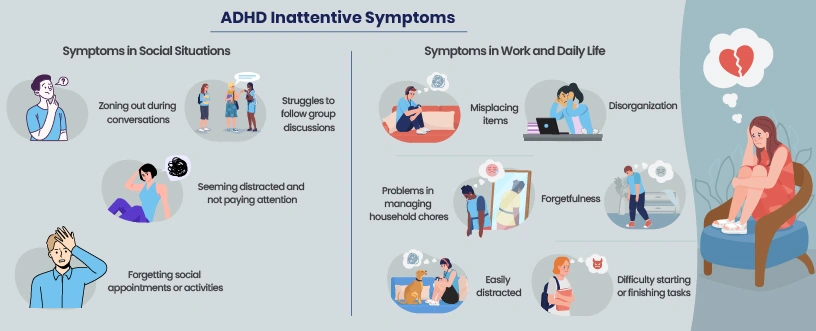
Symptoms in Work and Daily Life
- Difficulty starting or finishing tasks: Often procrastinate tasks that need mental effort and full focus. This results in incomplete work or missed deadlines.
- Disorganization: Experience difficulty organizing tasks, keeping track of deadlines, or work priorities. Their workspace or desks often appear messy.
- Struggle following instructions: Find it difficult to remember instructions regarding work, even after being explained clearly.
- Overlooked details or frequent mistakes: Overlooking details or skipping instructions for the tasks leads to errors.
- Easily distracted: External conversations, noises, or internal thoughts can quickly pull their attention away from the tasks at hand.
- Misplacing items: They lose items frequently, like important papers, phones, or keys, which results in time wasted on searching for these things.
- Forgetfulness: Tends to forget appointments, commitments, or even when he/she has made arrangements for such things.
- Problems in managing household chores: Cannot cope with household activities, and hence, there is a pile-up of work.
- Problems in managing time: Cannot estimate the time required to do things, and often ends up doing everything at the last minute.
Symptoms in Social Situations
- Zoning out during conversations: Seems attentive but may have trouble paying attention in conversations, resulting in not getting the point and interrupting.
- Struggles to follow group discussions: Trouble following along in conversations in which many people are speaking simultaneously.
- Seeming distracted and not paying attention: Could seem distracted due to thoughts wandering while involved in social situations.
- Forgetting social appointments or activities: Trouble remembering and forgetting to show up for social events due to poor memory skills.
Psychological and Attention Symptoms
- Daydreaming or mental drifting: Tends to become distracted and think about irrelevant things even in settings where concentration is important.
- Difficulty focusing: It can be difficult to sustain focus and attend to tasks that are lengthy or complex, despite motivation to finish them.
- Racing thoughts or distracted mind: Feel like the mind is preoccupied with irrelevant thoughts, thereby impeding the ability to concentrate on one thing at a time.
- Trouble reading extensively: They may like reading, but cannot complete books since their focus wanders.
Emotional and Behavioral Symptoms
- Frustrated with self: They may have frequent feelings of self-frustration, guilt, or overwhelm. This is due to their tasks remaining incomplete or constant mistakes despite putting in effort.
- Self-doubt or low self-esteem: The ongoing pattern of forgetting or having difficulty performing basic actions can result in self-doubt. It can cause a lack of confidence, especially in comparison to other people.
- Sensitive to criticism: Because of the frustrations caused by forgetfulness or disorganisation, individuals tend to be very sensitive to criticism.
Symptoms in Children
ADHD without hyperactivity symptoms can show up differently in children. The following are some common symptoms in younger individuals.
- Difficulties concentrating in class: A child cannot focus on lessons and classroom activities. They appear to be daydreaming most of the time.
- Forgetfulness in academic performance: The child usually forgets homework, school books, and other items needed at school.
- Gets easily distracted by the environment: Becomes easily distracted by outside noises or other children talking. They often are unable to finish assigned tasks.
- Inability to follow directions: May need directions repeated several times because they forget how to perform or get stuck halfway.
- Tendency to make mistakes carelessly: Tends to commit mistakes when doing homework. It happens despite understanding the material well.
- Problems with planning and organization: Cannot organize themselves adequately for school or maintain schedules.
- Refuses to do tasks which need attention: The child refuses to do homework or other assignments that need prolonged attention.
This ADHD type can affect daily life, from school and work to home responsibilities. It also impacts your social interactions and personal focus. The above symptoms help diagnose inattentive ADHD in children and adults. The first step is to recognize these symptoms, then treatment through therapy, medication management, or coping strategies.
Find an ADHD Specialist
Connect with an experienced ADHD provider for personalized evaluations and treatment to help improve focus, organization, and daily functioning.
✓ Experienced Mental Health Provider
✓ Therapy & Medication Management
✓ Telehealth & In-Person Appointments
✓ Most major insurances accepted
Expert consultation available · Flexible scheduling · Confidential care
What are the Causes of Inattentive ADHD
The following are some causes of inattentive ADHD.
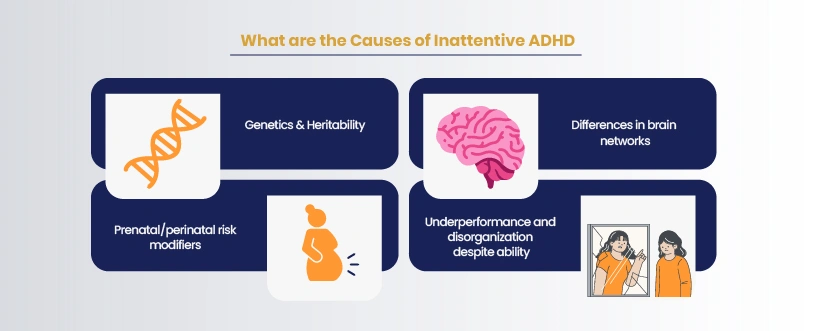
Genetics & Heritability
- Strong family aggregation; several genes associated with dopamine/norepinephrine systems and executive functioning systems
Differences in brain networks
- Frontostriatal and frontoparietal neural circuit abnormalities (related to sustained attention, planning, and working memory).
- Abnormal regulation of the default mode network is responsible for mind-wandering.
Prenatal/perinatal risk modifiers
- Prematurity and low birth weight.
- Prenatal exposure to nicotine/alcohol, environmental toxin exposure (e.g., lead).
- Adverse circumstances/stress can interact with genetic predisposition.
- Common complications, if left untreated.
Underperformance and disorganization despite ability.
- Safety issues and social frictions where instruction-following matters.
- Self-criticism, low mood, and anxiety.
How Inattentive ADHD is Different From Other ADHD Types
There are some differences between inattentive ADHD and its other types. Individuals experiencing this type of ADHD don’t show impulsive behavior and hyperactivity as in other types.
Major differences include:
- Symptoms Profile: Symptoms of inattentive ADHD mostly include problems in paying attention. Different types may exhibit different kinds of symptoms. Other types may show more impulsiveness or hyperactivity.
- Behavior: Individuals who have inattentive ADHD could appear to be daydreaming or distracted. Individuals with hyperactive-impulsive ADHD may come across as restless or interrupting.
- Diagnostic Challenges: Diagnosing this ADHD type is a little bit difficult. This is because it does not have as many symptoms as hyperactive-impulsive ADHD.
Correctly diagnosing this type is the key to the right treatment plan. Understanding the actual symptoms of inattentive ADHD helps psychiatrists to provide better treatment. This helps people reduce their symptoms and live a healthy life.
What are the complications of Inattentive ADHD?
This type of ADHD makes it difficult for you to stay organized and complete tasks. Moreover, it can also make you feel mood swings and impatience.
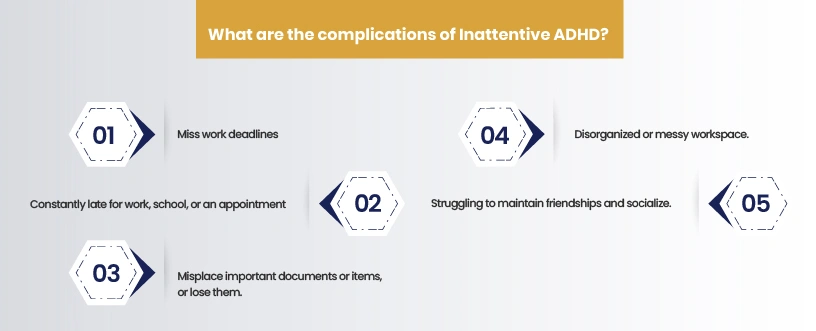
These negative behaviors can impact your relationship and performance at work or school. You might:
- Miss work deadlines
- Constantly late for work, school, or an appointment
- Misplace important documents or items, or lose them.
- Disorganized or messy workspace.
- Struggling to maintain friendships and socialize.
Your tendency to become distracted could also pose dangers in terms of your physical safety. This happens especially if you are employed or participate in risky situations. Because these situations require attention to important directions.
During your childhood years, people would scold you for certain behavior. Your teachers will tell you that you are being lazy for not submitting your homework. They often call you careless since you did not concentrate on their lectures.
None of these things is true. Your brain does not function like theirs. You are listening and absorbing information, but in your own unique way. Sometimes, it may be difficult for other people to understand what you are going through. Particularly, it is because they are not suffering from ADHD. This means that this ADHD type could also affect your psychological well-being.
When to Seek Professional Support
You need professional support when you experience chronic symptoms. These can be constant disorganization, difficulty focusing, forgetfulness, etc. Further, when these symptoms are interrupting your daily life, relationships, and work. It is necessary to recognize this type early to choose the proper treatment. If these signs have been present since childhood, they can affect your functionality and cause emotional dysregulation.
What is Inattentive ADHD Treatment?
There is no specific cure for this type of ADHD. But medications and treatment can help manage behavior and reduce the symptoms.
Treatments are similar for ADHD regardless of its type. Mental health care providers often suggest a combination of psychological therapies, medications, or psychoeducation.
Psychotherapy
In psychotherapy, there are numerous approaches. But its main purpose is for individuals to talk about the emotional impact of their behavior. Therapists can find healthful ways to manage the symptoms through talk therapy.
Cognitive Behavioral Therapy (CBT)
Cognitive behavioral therapy (CBT) is one of the most effective treatment plans for all ADHD types. It helps recognize the behavior and problems to create and implement self-regulation strategies. Moreover, it helps you manage thoughts, behavior, and emotions. With CBT, you will learn about automatic or irrational thoughts that are causing negative behavior. It helps you to adopt positive thoughts and behavior. CBT also teaches individuals about strategies to break tasks into manageable steps. Through this, they can develop better problem-solving skills.
Group Therapy or Support Groups
In this therapy session, your psychiatrist will help you learn from others who share a similar experience as you do. This is a helpful option to treat ADHD predominantly inattentiveness, and if you want to build social connections with others.
Parent Training
When a child is experiencing ADHD, family members usually have to understand their child’s condition. Professional and trained specialists will provide support or guidance for parents.
Family Therapy
In this, therapists will speak with each member of the family. They encourage family members, and the goal is to offer collective support for a child struggling with ADHD.
Final Words
Inattentive ADHD shows unique challenges for people. But it is possible to manage symptoms with the right treatment combination and strategies. Individuals can improve focus, manage their time better, and reduce feelings of overwhelm. Whether you are going for therapies, strategies, or medications, you can manage symptoms effectively with treatment. Inattentive type of ADHD is often unidentified, but with proper diagnosis and support can make all the difference.
At Orange Coast Psychiatry, our professional and experienced psychiatrists understand the ADHD complexities well. They are highly trained in diagnosing and treating all types of mental health disorders. We offer a comprehensive assessment to identify symptoms and develop a personalized treatment plan accurately. You can book both an in-person and a telepsychiatry appointment.