
Attention-deficit hyperactivity disorder (ADHD) is a neurodevelopmental condition that looks different for everyone. It severely impacts an individual’s feelings, behaviors, and ability to focus and function.
ADHD usually occurs in children, but can also persist in adulthood if it remains untreated. It encompasses a wide range of experiences.
Each person faces a unique set of symptoms and challenges. The symptoms depend on the type of ADHD. According to the DSM-5 criteria, ADHD is categorized into three clinical presentations: predominantly inattentive, predominantly hyperactive-impulsive, and combined.
Understanding the types of ADHD provides a framework for finding better treatment options and support for ADHD.
What Is ADHD?
ADHD is a condition that impacts the brain’s functions. People experiencing ADHD have differences in the brain that impact attention, control, emotions, working memory, planning, and alliance in other areas of life.
Despite its name, ADHD doesn’t always mean that one may “lack” attention. Rather, it makes it harder to pay attention or direct it to perform activities. However, the main symptoms of ADHD include inattention, hyperactivity, and impulsivity, but the symptoms vary. There are different presentations (subtypes), which include predominantly inattentive, predominantly hyperactive‑impulsive, and combined types.
All these types have a different pattern of symptoms and risk factors. As these look like “laziness,” “defiance,” or “neglect” from the outside, it is often the brain struggling to manage attention, energy, and self‑control.
What Happens in the ADHD Brain?
ADHD is a neurodevelopmental condition. Most people think that it occurs because of bad parenting or too much screen time. However, people with this condition have slightly smaller or slower-developing brain areas, which are responsible for controlling attention, planning, and impulse control. The ADHD brain remains in “underactive” communication between brain regions that control focus.
People in this state have trouble turning off the default mode network, the part of the brain that daydreams when they are not focusing. In other words, ADHD brains can notice everything, but they have to work extra hard to stay focused on one thing.
Types of ADHD
ADHD is categorized into three presentations as per the DSM‑5 (the diagnostic manual used by mental health professionals).
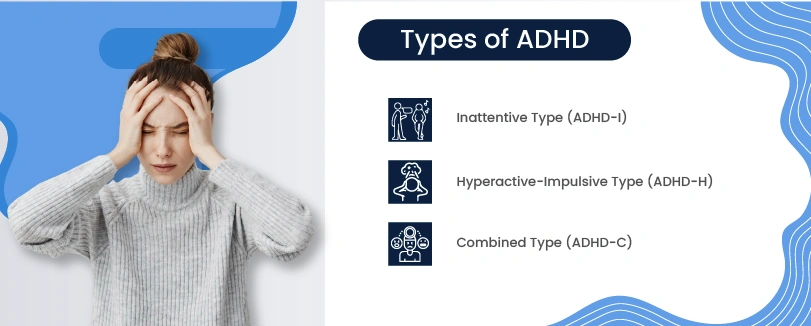
Understanding the types helps in diagnosing the exact condition and allows experts to provide more effective treatments.
- Inattentive Type (ADHD‑I)
- Hyperactive‑Impulsive Type (ADHD‑H)
- Combined Type (ADHD‑C)
According to the National Library of Medicine, 62% of adults had the combined subtype, 31% the inattentive only subtype, and 7% the hyperactive/impulsive only subtype.
Note: All these types are not totally separate disorders. Instead, these are three different ways the same condition can show up in everyday life.
1. Predominantly Inattentive Type (ADHD-I)
People experiencing this ADHD-I struggle mostly with attention, focus, and concentration. Here are some of the core features that may help in recognizing the condition, these include:
- Individuals in this state remain distracted, even by the little distractions that others might easily ignore. These distractions, which can be background noises or irrelevant thoughts, significantly disrupt focus during work, reading, or other activities.
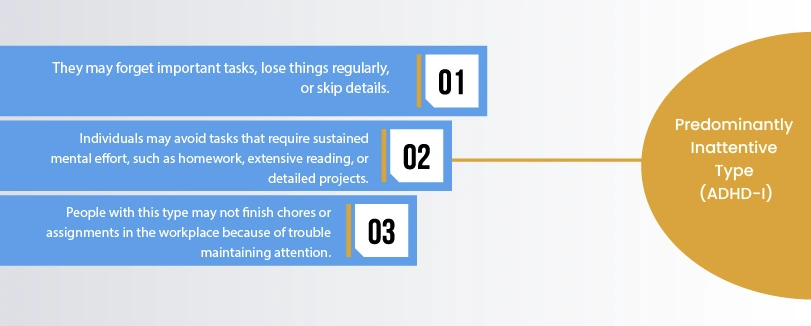
- They may forget important tasks, lose things regularly, or skip details.
- Trouble organizing tasks, difficulties managing time effectively, and meeting deadlines can feel overwhelming, which results in incomplete tasks and procrastination.
- Individuals may avoid tasks that require sustained mental effort, such as homework, extensive reading, or detailed projects.
- People with this type may not finish chores or assignments in the workplace because of trouble maintaining attention.
- They may often remain in daydreaming, mental fog, or feeling constantly “spaced out.”
- Some people also experience “slow cognitive tempo,” a pattern of dreaminess, slow processing, and being inactive.
How does ADHD‑I look in real life?
ADHD inattentive type can severely impact everyday life activities. In real life, it can be seen in the following ways:
- Student’s life as they understand the project but forget the points due to incomplete work.
- An employee who performs well and has better ideas but misses deadlines, misplaces files, or forgets the main key steps.
- It can be seen in parents, as they love their child but frequently forget school forms, events, or the instructions from teachers.
However, all these individuals are often misjudged as careless, unmotivated, or disconnected, but in reality, their brains are struggling to manage attention and working memory.
2. Predominantly Hyperactive‑Impulsive Type (ADHD‑H)
ADHD-H is characterized by constant motion, excessive talking, and impulsive actions. Individuals who have this type may show the following signs:
- Individuals have an uncontrollable urge to move, and they struggle to stay still. It can be noticeable in places where sitting quietly is expected, such as in classrooms or during meals.
- Trouble remaining seated, as they may stand up, run around, or jump, even when it’s inappropriate or unsafe.
- Individuals may interrupt others and speak at inappropriate times.
- They remain in a hurry and are unable to wait for their turn, such as in games or group situations.
- They have difficulty engaging in quiet activities, such as reading, doing homework, or even meditation, which can be challenging.
- Acting without thinking of outcomes, as impulsivity leads to risky behaviors, impulsive decisions, or socially unacceptable actions.
Note: Hyperactive‑impulsive symptoms usually arise earlier than inattentive symptoms and are frequently noticed in early years of life.
How does ADHD‑H look in real life?
People in this state have difficulty maintaining social connections, meetings, and other tasks because of their heart-healthy symptoms.
Here is how it shows up in real life:
- Children in this state constantly remain out of control and interrupt their teachers in the classroom. They may talk over others, blur things out, and get into trouble for not thinking before speaking.
- An adult who cannot sit through meetings without fidgeting, pacing, or multitasking on their phone
This behavior is more visible and causes disturbance in everyday activities. Individuals with ADHD‑H are often identified earlier in men.
3. Combined Type of ADHD
The combined type of ADHD is one of the most common forms of the disorder. People in this state experience the symptoms of both inattention and hyperactivity-impulsivity. It leads to a wide range of challenges that can impact every aspect of life, such as performance in academics, work productivity, social connections, and self-esteem.
Here are some of the common symptoms of this ADHD-C:
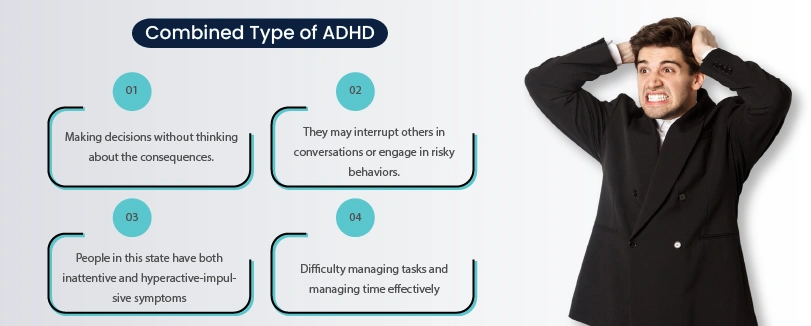
- People in this state have both inattentive and hyperactive-impulsive symptoms as they have trouble managing daily tasks and maintaining relationships.
- Difficulty managing tasks and managing time effectively, which can result in missed deadlines, forgotten appointments, and feelings of overwhelm.
- They may struggle to remain seated and be unable to concentrate on tasks for a longer period of time, especially around bedtime.
- Making decisions without thinking about the consequences.
- They may interrupt others in conversations or engage in risky behaviors.
- People with ADHD-C may struggle with completing and finishing tasks due to their tendency to be distracted by more exciting activities.
- They may struggle in maintaining social connections because of the combination of impulsivity and difficulty in maintaining attention. It may occur as trouble listening to conversations or struggling with social cues, which can lead to misconceptions and conflicts.
- People in this state face challenges with attention and impulse control, which can lead to erratic performance. They may excel in the areas of their interest but struggle significantly everywhere else.
How does ADHD‑C look in real life?
People experiencing this condition have the following struggles in real life:
- A child with this state constantly remains distracted in school, is unable to sit in a seat, misses instructions, loses assignments, and rushes through work.
- A person who talks fast and excessively may have difficulty managing details, multitasks chaotically, and makes impulsive commitments
- ADHD-C in a parent who is both forgetful about routines and constantly “on the go,” misrepresenting many tasks but finishing a few.
So, it is seen that people experiencing this condition can share notable functional impairments at school, work, and in relationships. It is because multiple parts of executive functioning are affected.
Other Types of ADHD
There are seven other types that are not officially diagnosed by the DSM-5 criteria. Some of the expert psychiatrists, like Dr. Daniel Amen, say there are 7 subtypes based on brain imaging and clinical patterns. These include Classic, Inattentive, Overfocused, Temporal Lobe, Limbic, Ring of Fire, and Anxious types.
These types are not part of standard diagnostic criteria but can be useful as conceptual frameworks to understand why ADHD can look so different from person to person. However, formal diagnosis and treatments still rely on the three official presentations.
How to Diagnose 3 Types of ADHD?
It can only be diagnosed by a mental health professional with the most up-to-date version of the Diagnostic and Statistical Manual of Mental Disorders (DSM). The diagnosis involves a comprehensive look at the personal and medical history. Some questions to rule out the symptoms, including when the symptoms began and how they affect the patient’s life. They may look for the physical symptoms, such as anxiety disorders or other mental health conditions.
However, if someone is diagnosed with ADHD later in life, the symptoms must start by age 12 for a diagnosis to occur. They must also be present in two or more settings, such as work, home, and social activities, which interfere with functioning.
Do ADHD Types Change Over Time?
The ADHD types can most certainly change over time. Most people feel changes in their symptoms as they grow older.
For example, external symptoms of hyperactivity, such as running around the classroom as a child, might turn into inner restlessness in adulthood. People who struggle with fidgeting could become more subtle. There may be an increase in frustration as symptoms interfere with adult life.
Sometimes, people find that different approaches and strategies are a better fit as they grow older and their symptoms also change. However, a mental health provider who specializes in ADHD treatment can help offer treatments tailored to the unique condition.
Treatment for the Different Types of ADHD
ADHD is a curable condition; it can be treated with a combination of treatments. Combining therapy and medication typically yields better outcomes. Mental health experts recommend psychotherapies like CBT. The most common form of therapy that helps with all types of ADHD is called cognitive behavioral therapy (CBT). CBT helps to identify unwanted thinking patterns and habits and helps in maintaining unique strategies to regulate emotions, thoughts, and actions. Ultimately, CBT helps recognize negative behaviors and replace them with positive ones.
Additionally, experts also recommend medications that help in increasing the neurotransmitters in the brain, such as Stimulant medications. It is one of the most effective medications that helps in reducing the symptoms of ADHD. A mental health expert monitors the condition closely and may adjust the dosage of medication. However, if stimulants are ineffective or lead to side effects, a mental health expert may recommend non-stimulant medications. Non-stimulant ADHD medications also work by increasing the levels of two neurotransmitters (dopamine and norepinephrine) in the brain, which help regulate brain activity.
Moreover, there are some other ways to manage ADHD symptoms that include Dialectical Behavior Therapy (DBT) and Support groups. People experiencing ADHD build healthy connections through support groups and remain consistent with the treatments. It also helps in reducing loneliness and isolation.
Nurture Your Mental Health at Orange Coast Psychiatry
Mental well-being is a very important part of overall well-being. We understand how a person with mental health issues faces challenges every day. If you or any of your loved ones are struggling with ADHD, help is within reach!
Orange Coast Psychiatry is the leading platform that offers the best psychiatric services for people of all ages. Our highly expert team of professionals offers a variety of evidence-based treatments that include psychotherapy, group therapy, and more. We provide careful and comprehensive psychiatric evaluations and offer personalized treatment plans according to your unique needs. Orange Coast Psychiatry is not just treating mental health issues but also building foundations for better cognitive abilities.
Book your consultations today!