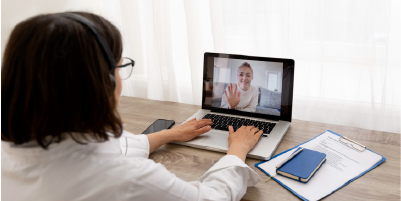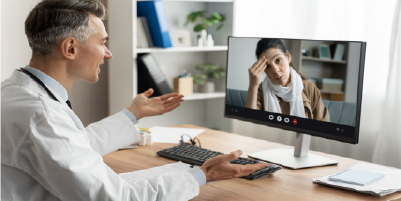
Telehealth refers to the delivery of health care services from a distance with the help of modern technology like mobile phones, laptops and tablets. Most importantly, it involves video calls between patients and their health care providers. The meaning of Telepsychiatry is that specialized form of telehealth that focuses on mental health services.
How Telepsychiatry Works?
Telepsychiatry operates through direct interaction between a psychiatrist and a patient through video call conferencing. It also allows psychiatrists to connect with other health care professionals, such as primary care doctors. It helps to provide mental health consultation and expert guidance.
Mental health care delivery happens through live, interactive communication. This can take place through video calls or audio-only sessions when video is not possible or preferred. In some cases, medical information such as images or videos can be recorded or preferred.
In some cases, medical information such as images or videos can be recorded and transmitted securely to a psychiatrist or another clinician for review and assessment.
The Role of Mobile Technology in Mental Health Care
Modern people now use mobile health as part of their care. These tools include smartphone applications, smartwatches, and other devices that monitor health data. When these devices are used in coordination with psychiatrists, mobile health technology can provide additional ways to assess symptoms and support treatment plans.
The Benefits Of Telepsychiatry
Video and audio-based telepsychiatry helps meet patients’ needs for convenient, affordable, and accessible mental health services. It can benefit patients in several ways, such as care that comes to the patient’s place, whether at home, work, or another private space. This is a specialty care that might not otherwise be available, such as pediatric care or care in rural areas. Here are the general benefits of telehealth for mental health.

- Bring care to the patient’s place
- Better integration of mental health care with primary care, which leads to improved treatment results.
- Reduce the need for visiting the session rooms in an emergency.
- No delay in care
- Improve continuity by having less need to take time off work or arrange childcare and family care services to attend an appointment at a distant location.
- Reduce the transportation barriers, such as the lack of a vehicle or the burden of long drives to appointments. It also reduces the traveling cost for patients.
- Less stigma associated with mental health care, as patients can attend appointments privately from their own preferred place.
- Enhance feelings of safety, security, and privacy for people.
While some people might feel uncomfortable or awkward talking on screen with mental healthcare professionals, the data from the American Hospital Association shows that most people are comfortable with this form of mental care.
Some people may be more relaxed and willing to open up from the comfort of their home or a convenient local facility. With the expansion of telepsychiatry over the course of the COVID-19 public health emergency, opportunities to use hybrid treatment options have been on the rise.
Telepsychiatry helps psychiatrists to treat more patients in distant locations. So the treatment ratio increases. Psychiatrists and other clinicians need to be licensed in the states where the patients are presented.
Research Evidence for Telepsychiatry Effectiveness
Substantial research evidence supports the effectiveness of telepsychiatry. According to the National Libraray of Medicine, studies consistently show high satisfaction rates among patients, psychiatrists, and other mental health professionals who use this approach. According to them, over 70% of patients and psychiatrists were satisfied with telepsychiatry.
Telepsychiatry performs as well as traditional in-person care across multiple important measures, including diagnostic accuracy, treatment effectiveness, quality of care, and patient satisfaction. The protection and security of private information is equal to that in face-to-face appointments.
People with autism spectrum disorders, severe anxiety disorders, or physical limitations often find remote treatments.
Studies also demonstrate that telepsychiatry is especially effective for the treatment of post-traumatic stress disorder (PTSD), depression, and attention deficit hyperactivity disorder (ADHD). The research base for telepsychiatry continues to grow as more providers and patients adopt this approach to care for individuals.
Telepsychiatry has been found especially effective with respect to the treatment of PTSD, depression, and ADHD.
Mental Health Conditions Treated Through Telepsychiatry
Depression and Anxiety Disorders
Multiple studies compare traditional face-to-face care with telepsychiatry for various depression and anxiety disorders.
These studies show no significant differences in outcomes between the two approaches. Telepsychiatry has been used successfully in primary care settings and in mental health patients who receive telepsychiatry treatment for depression.
It also shows significant improvement in their symptoms, as measured by standard depression assessment tools. These improvements occur regardless of the specific medication treatment the patient receives. The results confirm that telepsychiatry produces outcomes comparable to traditional face-to-face treatment for depression.

Patients with certain anxiety disorders, such as agoraphobia, may benefit especially from telepsychiatry. This is particularly true in acute situations, when travel to an outpatient clinic could worsen symptoms. For people with specific phobias, virtual exposure therapy delivered through telepsychiatry has shown symptom improvement after three months of treatment.
Bipolar Disorder and Related Conditions
The application of video conferencing at the clinical level in the case of Bipolar Disorder (BD) can establish collaborative treatment models necessary for therapeutic management.
Telepsychiatry programs for bipolar disorder have shown significant improvements in manic symptoms, depressive symptoms, behavioral disturbances, and psychological quality of life. However, these programs have not shown improvements in physical health, subjective feelings of well-being, risk of self-harm, or alcohol consumption.
This suggests that telepsychiatry may have limitations when it comes to addressing certain specific symptoms, and a combination of telepsychiatry and in-person care may be most effective for some patients.
Schizophrenia and Psychotic Disorders
For patients with schizophrenia, telepsychiatry has proven useful in several ways. It improves medication adherence and helps maintain stability in treatment response, which fills an important gap for patients who have difficulty accessing traditional psychiatric care. The areas that benefit most include improved communication between patients and their care team, reduction in positive symptoms, fewer emergency room visits, and shorter hospital stays when hospitalization is necessary.
Both patients and clinicians report high satisfaction levels with telepsychiatry for the treatment of schizophrenia and other psychotic disorders.
Autism Spectrum Disorders (ASD):
The development of a therapeutic relationship with patients who have autism spectrum disorders can present unique challenges. Telepsychiatry offers a valuable alternative for patients who are reluctant to attend face-to-face clinical evaluations or who find in-person visits overwhelming.
Parents of patients with autism spectrum disorders report high satisfaction with telepsychiatry services. While online video appointments may capture less nonverbal information than in-person appointments, many adolescents and patients with autism spectrum disorders find telepsychiatry more acceptable and less stressful than traditional office visits. The familiar environment and reduced sensory demands of home-based care can make treatment more effective for this population.
Substance Use Disorders
The literature in the National Library of Medicine is relevant to TP in substance use disorders. In terms of effectiveness, however, there are no studies that consider TP to be inferior to face-to-face treatment for substance use disorder. Yet, there is a need for more research on this.
Telepsychiatry for Children and Adolescents
The famous study carried out in 2003 in the National Library of Medicine about childhood depression. According to them, there were appearance of randomized clinical trials with TP and comparative pre and post–treatment studies on various disorders in recent years. Although mostly with small samples, these studies have shown promising results specifically in patients with Autism spectrum disorder (ASD) and moderate–severe behavioral problems, and have demonstrated that telemental intervention with parents significantly reduced disruptive behaviors compared to treatment as usual, in patients with attention deficit hyperactivity disorder. In general, the literature shows that a wide variety of disorders, such as anxiety, obsessive-compulsive disorder, tics (sudden, repetitive, and involuntary movements), and behavioral disorders have been successfully treated with TP in both children and adolescent populations.
Moreover, school-based telepsychiatry has grown rapidly in the United States in recent years. It has gained acceptance because it is cost-effective and convenient for patients and families. Studies show that school-based telepsychiatry is more efficient than traditional face-to-face services. One study found that it saves approximately 28 hours per month in travel time for families and providers.

Another of its main benefits lies in the reduction of parental requests for leave from work, as well as a reduction in children’s absences from school. The results show fewer cancelled appointments compared to usual practice.
Group Telepsychiatry
Group therapy delivered through telepsychiatry offers advantages compared to traditional in-person group sessions. It can include patients who would not normally attend group therapy because of schedule conflicts, travel difficulties, symptoms of their condition, or embarrassment about sharing their experiences face-to-face with others.
For effective group telepsychiatry sessions, it is best to limit the group to 10 to 12 people. Larger groups make it difficult for participants to interact meaningfully and form connections with each other. Sessions should have a clear structure for taking turns to speak, which helps avoid continuous interruptions. The session should open 10 to 15 minutes early so that technical support can be provided to anyone who experiences connection problems.
In the online format, quieter or more reserved participants may be overlooked more easily than in person. Therapists need to make an extra effort to notice and engage all participants. As with in-person groups, it is essential to create an atmosphere of trust and help participants feel that they belong to the group.
Successful Implementation of Telepsychiatry
For telepsychiatry to work well, clear communication is essential across three key groups: the clinical staff (which includes not only psychiatrists but the entire care team), the administrative staff (those who manage schedules and clinical operations), and the patients themselves. All three groups must understand that telepsychiatry services are available and how they work. Without this shared knowledge, telepsychiatry cannot be implemented properly.
The Future of Telepsychiatry
The COVID-19 pandemic advanced the development and adoption of telepsychiatry across the country. When it became the primary method of communication with patients during lockdowns, many providers and patients overcame their initial hesitation and discovered that telepsychiatry is a powerful clinical tool in mental health care.
Research confirms that telepsychiatry has similar validity, efficacy, and effectiveness compared to traditional face-to-face care. Many experts believe that the continued enhancement of telepsychiatry will be essential for the future of mental health care.
Online mental health services at Orange Coast Psychiatry
At Orange Coast Psychiatry, we are committed to providing high-quality telepsychiatry services that make mental health care more accessible, convenient, and effective for all our patients. Whether you choose telepsychiatry sessions, in-person appointments, or a combination of both, our goal is to provide you with the care that best meets your individual needs and circumstances. We provide telepsychiatry for children and adolescents, and for patients who live in rural or isolated areas where access to mental health specialists is limited.
Find the best possible time and contact us for the sessions. We will be happy to work for your mental well-being.