
Have you ever met someone who feels like they are better than everyone else, and always bragging and belittling others? Or have you met someone who is constantly competing for attention or comparing themselves to others?
If the answer is surrounding yes, you might have witnessed a superiority complex!
A superiority complex is basically a belief in which people think they are superior in abilities, importance, or value. Though it is just an exaggeration and a delusional feeling. People in this state just adopt this behavior in order to compensate for their feelings of inferiority.
However, every individual has a superiority complex in different things. Some people act superior because of their appearance, some because of money, and some because of their abilities.
“Superiority complex at its core is a defense mechanism for hiding one’s insecurities.”
—psychologist Alfred Adler.
People in this state are very mean, smug, and have low self-esteem. However, it severely disturbs the overall well-being, as most of the time, they may not even be aware of how their actions come across to others.
Understanding this condition can help navigate it in a better way.
The Psychology of Superiority Complex
The term superiority complex ” was coined by Alfred Adler, an early psychologist, in his theory of individual psychology. In this theory, he identified that superiority complexes are the reactions to a deep-rooted feeling of inferiority. So, it’s a feeling that one is superior to everyone around them. It’s a defense mechanism to protect the weak inner self.
People who have inferiority issues have a very hard time convincing themselves that they have actually achieved everything. But the inferiority still remains there! To overcome that, they play up their attainments to make themselves feel better.
However, it is not directly a mental health illness, but it can lead to personality traits like narcissism, arrogance, and emotional insecurity. Moreover, if it remains untreated, it can severely impact mental health and destroy friendships and family dynamics.
Signs of Superiority Complex
Individuals experiencing this state often have flattering opinions of themselves. They think like they’re smarter, better, or more capable.
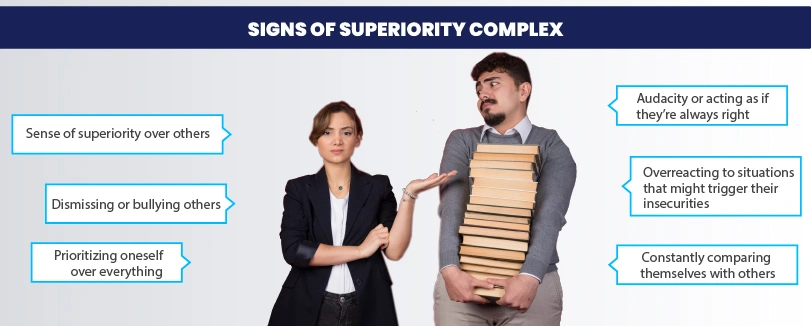
Here are some of the common signs of a superiority complex:
- Sense of superiority over others
- Audacity or acting as if they’re always right
- Unwilling to pay attention to the needs of other people
- Constantly comparing themselves with others
- Dismissing or bullying others
- Prioritizing oneself over everything
- Overreacting to situations that might trigger their insecurities
- Reacting with anger or blaming others rather than acknowledging one’s own mistakes
The Hidden Connection to Inferiority Complex
At its core, a superiority complex is very linked to the inferiority complex. It can be explained further as if a person has internal weak issues, like low self-esteem, unvalued, or felt rejected. They come up with a new perspective by making others feel inferior. These behaviors give them satisfaction, and they feel powerful. That’s how, instead of showing their feelings, they hide them with boldness.
People avoid their weaknesses by developing a feeling of superiority, and this is how both are linked.
Types of Superiority Complex
It’s a defense mechanism where people have a sense of being better than others.
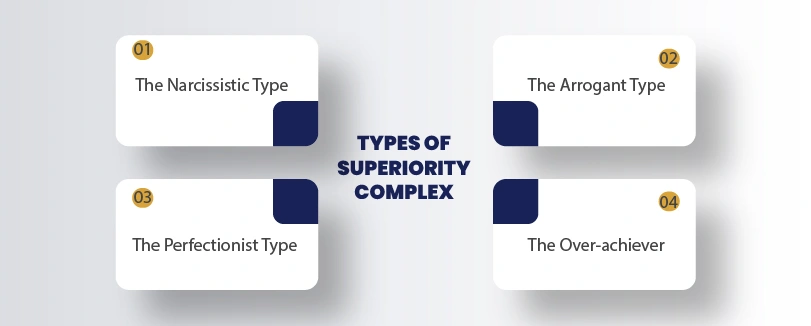
It is basically a mask for deep-seated insecurity and low self-worth. It occurs in various ways and has different types.
Here are some of the common types of superiority complexes
1. The Narcissistic Type
Narcissism is directly associated with a superiority complex. People in this state have a false feeling of importance and demand respect. They think they are special, always right, and superior to everyone. They don’t think about the feelings of others; instead, they demand special treatment and admiration. This behavior is not intentional, but emotional armor.
2. The Arrogant Type
It’s a type of superiority complex in which people become arrogant, rude, and have a dismissive attitude. People in this state frequently hurt others because they have a fear of being rejected or failing. This behavior occurs automatically and causes difficulties in everyday life.
3. The Perfectionist Type
People in this state always remain in fear that they might make mistakes. They make themselves controlled in every area of life. They may feel like working hard makes them the perfect one! Also, they have difficulty trusting others as they fear others will not meet their standards, so this tendency makes them so workaholic that they even forget about their health and hygiene.
4. The Over-achiever
Individuals experiencing this condition often struggle to overcome personal weaknesses. Such as getting lip fillers if there’s any small flaw, wearing heels to look taller, or reading more to get all the knowledge. They become overly dominant and aggressive to prove they have everything that a perfect person should have. However, it further leads them to emotional depletion.
The Effects of Superiority Complex
The superiority complex is an unsupported belief that you’re better than other people. It severely damages and disturbs the quality of life and leads to several challenges.
Here are some of the common effects of a superiority complex:
Low self-worth
People in this state have low self-esteem because they feel like they are less valuable.
They feel like they have too many flaws, so they mask their inferiority by acting superior. However, if you brag about your skills but other people learn that you exaggerated, they will think less of you.
Broken Relationships
People experiencing this personality trait have difficulty managing relationships. Why, because they think that they are superior, and they show their dominance and power over everything. It eventually leads their partners to feel unheard, as they are emotionally unavailable. They revolve around themselves most of the time and become overly confident and brag to their partners.
Mental Health Strain
A superiority complex is a way of covering up insecurities. However, it severely damages self-esteem. People experiencing this state are likely to feel overconfident in their capabilities. They tend to remain alone, shrink their social circle, which leads them to develop depression, anxiety, and other mental health disorders.
Career Problems
As we already know, people in this state are very confident, so when they appear for an interview, they pretend like they know everything and can handle all the tasks. Although they just bluff about it! So it leads to significant anxiety and might also lead to unemployment.
What are the Root Causes?
A 2022 study by Adler’s work indicates that superiority complexes usually occur because of childhood experiences and mental health conditions.
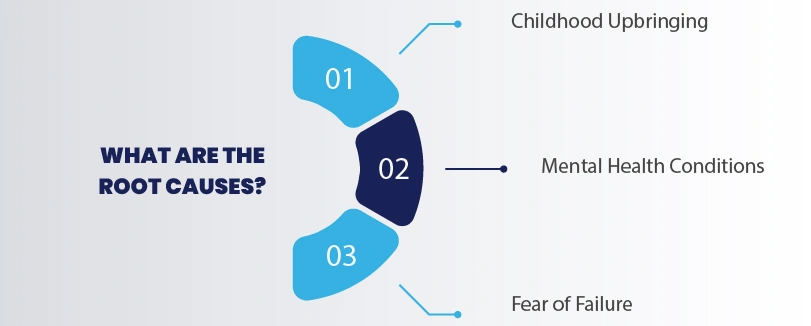
1. Childhood Upbringing
Parents who overly pamper their children make them overly dependent. Because of this, they are unable to make life decisions, which shakes their confidence and skill development. However, they think that the whole world revolves around them, which suppresses their creativity. When they eventually interact with others who are more capable, they may feel inferior. In the long run, they develop a superiority complex in order to avoid the reality of the world.
2. Mental Health Conditions
As per the research by Adler, individuals who are struggling with mental health conditions may also develop superiority complexes. It is because they have difficulty coping with real-life scenarios, which makes them deeply discouraged. However, this eventually causes individuals to develop feelings of an inferiority complex.
3. Fear of Failure
Individuals with this complex remain in excessive fear of failing. Why, because they feel like they are worthy and capable of everything, and when they fail, they become aggressive. They don’t acknowledge their mistakes even after making them, because they think acknowledging mistakes might expose their imagined worthlessness.
How to Recognize if You Are Experiencing a Superiority Complex?
This condition is not always easy to determine, as it can occur in confidence or leadership. Here are some of the patterns that help if you are experiencing it.
| Common Behavior | What it means |
| Constant bragging | Seeking validation because of low self-worth |
| Overreacting and criticizing | Just wanted to tidy the fragile ego |
| Expecting to get special treatment wherever they go | It is because one may think they are superior in every thig weather its skills, colors, finances, or any other thing |
| Talking badly, or making other to feel down | It is because they wanted to hide their inferiority |
| Intense need to control | They have a fear of vulnerability |
How Can a Superior Complex Be Diagnosed?
This condition is not a mental health disorder and is not listed in the Diagnostic and Statistical Manual of Mental Disorders, Fifth Edition (DSM-5).
It can only be diagnosed by a mental health professional by looking at the symptoms and childhood history. They conduct some questionnaires and interviews with the individuals who are experiencing this condition and also with the family members. However, it’s very close to narcissistic personality disorder (NPD) in the diagnosis, but they are different conditions.
It’s a little confusing to diagnose, as people who are experiencing this have issues with attention and learning. So in most cases, they’ve been struggling because they’re neurodivergent and haven’t been diagnosed yet.
Treatment Approaches
Most of the people think that it’s part of their personality now, which can’t be changed! However, it is highly curable with the right professional support. There is no single standardized treatment, but therapists customize plans to help individuals.
Some of the common therapies that can help include:
Adlerian therapy, this therapy was developed by the psychologist Alfred Adler. In this therapy, a mental health professional helps individuals to overcome feelings of inferiority and create a healthy lifestyle. The therapist makes accurate choices to achieve success. It helps them to develop coping mechanisms and makes them come out of the unconscious drive.
Additionally, Cognitive Behavioral Therapy (CBT), is an evidence-based therapy that helps in reducing the negative thoughts and patterns. In this therapy, the individual shares their feelings, and the mental health professional changes the feelings into a positive direction. Also, Psychodynamic Therapy, in this approach, a mental health professional looks deeper into the patient’s past. The main goal is to bring unconscious patterns and unresolved conflicts, and change them. It helps in reducing deep-seated trauma and helps individuals to deal with it in a healthy way.
Furthermore, in some cases, the mental health professionals also recommend Medications along with therapies, such as antianxiety, antipsychotics, and antidepressants, in order to get accurate outcomes.
Find Care at Orange Coast Psychiatry
Asking for help is an act of courage, not weakness! If you notice any signs of a superiority complex in yourself or any of your loved ones, seek professional help.
At Orange Coast Psychiatry, we have a team of certified mental health professionals who offer effective, compassionate treatments. Our team helps individuals in examining matters about self-worth, ego, entitlement, and relationship problems in a secure and safe environment. We cover a wide range of insurances and also offer a self-pay option, so you don’t have to worry about the bills. If you have any issues with commuting or live far from our location, you can also get virtual treatments from the comfort of your home.
You deserve clarity, healing, and emotional peace
Make a call today and book your consultations!