
When someone repeatedly appears ill, seeks frequent medical care, or undergoes numerous tests, it can be difficult to understand what is really happening. The symptoms may seem genuine, while the behavior may be driven by an underlying psychological need.
Factitious disorder can be especially challenging to recognize because the person may go to great lengths to convince others that they are sick. This can leave families and healthcare providers confused about what they are seeing and how to respond.
So, what causes this behavior, and how can factitious disorder be recognized and treated? In this guide, we explore the signs, types, possible causes, diagnosis, and treatment approaches, along with when professional support may be needed.
What Is Factitious Disorder?
Factitious disorder is a mental health disorder in which someone acts like they are sick or makes someone else sick. They fake the medical symptoms on purpose. This differs from lying about being ill. A person can even lie about medical history or fake lab results. Factitious disorder involves a sustained pattern of deception aimed at obtaining medical attention for its own sake. It can take the following forms:
- Fabricate symptoms that do not exist
- Exaggerate symptoms from a minor condition
- Manipulate lab samples, medical records, and even test results
- Induce genuine illness through misuse of medication
What Is Factitious Disorder According to the DSM-5-TR?
DSM-5-TR sets out the following criteria for factitious disorder imposed on self:
- Falsification of physical or psychological symptoms or induction of disease associated with identified deception.
- The person presents themselves as ill or injured
- The deceptive behavior is evident even in the absence of obvious external rewards
- The behavior is not better explained by another mental disorder.
What Are the Types of Factitious Disorder?
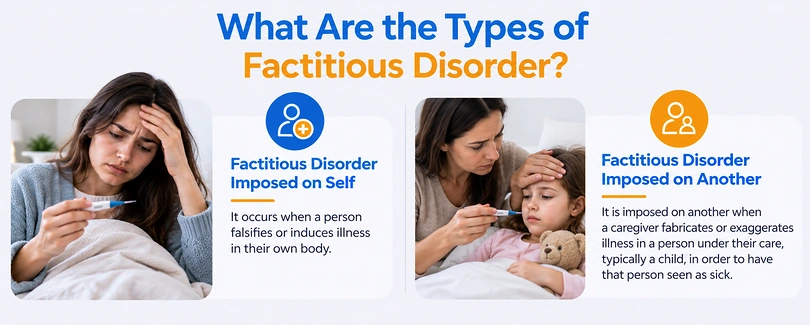
Factitious disorder is classified into two forms based on who bears the falsified illness. One type is when the disorder is imposed on oneself, and the other is when it is imposed on another. Each form is described by the kind of symptoms it presents and whether the pattern occurs once or repeats over time.
Factitious Disorder Imposed on Self
It occurs when a person falsifies or induces illness in their own body. This was historically called Munchausen syndrome. Clinicians describe the condition according to the symptom type:
- Present physical signs such as pain or wounds.
- Present psychological signs such as hallucinations or memory loss
- Combine both physical and psychological signs and present them.
The DSM-5-TR also specifies the course of the disorder as either a single episode or recurrent episodes, since some patients present once and never again, while others cycle through this pattern for years or decades across multiple providers and facilities.
Factitious Disorder Imposed on Another
It is imposed on another when a caregiver fabricates or exaggerates illness in a person under their care, typically a child, in order to have that person seen as sick. The person bearing the medical harm is not the person driving the deception. This form of disorder is serious, as the caregiver who fabricates the symptoms can expose the child to unnecessary procedures or medications.
A systematic review of 314 published cases across North America, Europe, Asia, and beyond found that more than 40% of child victims received unnecessary medical treatment as a direct result of the abuse, and nearly 8% died Wang et al., 2026, Frontiers in Public Health. Because a dependent is involved, factitious disorder imposed on another raises safeguarding concerns and typically requires child protective involvement alongside psychiatric assessment of the caregiver.
Why Do People Develop Factitious Disorder?
Researchers have not found a confirmed cause of factitious disorder. A retrospective review of 455 published cases found that patients were disproportionately young women with a background in healthcare work. Many had a documented history of childhood illness or hospitalization (Yates & Feldman, 2016, General Hospital Psychiatry). The following are considered the possible cYates & Feldman, 2016, General Hospital Psychiatry)auses:
- Childhood illness or trauma
- History of abuse or neglect
- Previous hospitalization
- An unmet desire for care or attention
- Difficulties with identity
- A fragile sense of self-worth
- Earlier experiences in which being sick brought comfort, safety, or connection
- Co-occurring mental health conditions
Factitious Disorder and Personality Disorders
Clinical literature reports an association of factitious disorder and a few other personality disorders. The most common is borderline personality disorder. A narrative analysis of comorbid presentations found that clinicians frequently observed features of both conditions together. They recommended screening factitious disorder patients for borderline personality disorder as part of a full assessment (Lazzari & Rabottini, 2023, Psychiatria Danubina). This is simply an association, not a claim. A personality disorder does not cause factitious disorder, and having a personality disorder does not mean a person will develop it.
What Are the Signs and Symptoms of Factitious Disorder?
The early symptoms of factitious disorder are harder to spot than the fully developed pattern. Early on, the behavior looks like a run of bad medical luck. A few of the hidden symptoms include the following:
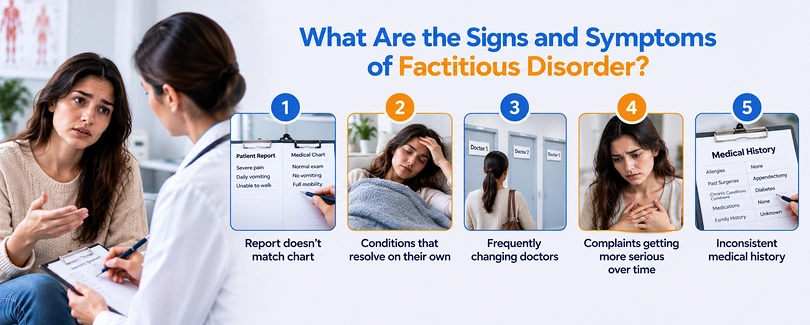
- Inconsistency between what the person reports and what a chart shows.
- Repeated medical conditions that resolve without a clear cause.
- A person frequently changes providers or sometimes expresses dissatisfaction with care.
- Gradual escalation in the seriousness of complaints
These signs become clearer only in retrospect. One suspicious behavior does not indicate factitious disorder. The other common symptoms include the following:
- Report a medical history that is inconsistent
- Present symptoms that do not match objective test results
- Visit hospitals or clinics with unusual frequency
- Seek treatment from multiple providers
- Demonstrate unusually extensive knowledge of medical terminology and procedures
- Develop symptoms when unobserved or under specific circumstances
- Request additional tests, scans, or invasive procedures repeatedly
- Provide misleading or fabricated details about prior diagnoses or treatments
How Is Factitious Disorder Diagnosed?
There is no single medical test that confirms factitious disorder. Diagnosis depends on the overall pattern of behavior and a full clinical assessment, not a lab value or scan. A psychiatrist includes the following points during the assessment:
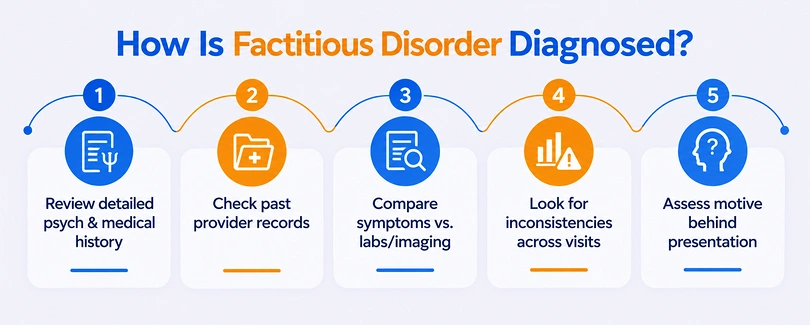
- Review the person’s psychiatric and medical history in detail
- Examine records from previous providers and facilities
- Compare reported symptoms against objective findings such as labs or imaging
- Look for inconsistencies across different healthcare encounters
- Assess the circumstances and possible motivation behind the presentation
- Rule out other psychiatric and medical explanations for the symptoms
- Evaluate any co-occurring mental health conditions that may need separate treatment
Psychological Disorders That Can Mimic Illness
Psychiatrists assessing possible factitious disorders also rule out the conditions in which a person experiences real symptoms rather than faking them. These considerations include the following:
- Somatic symptom disorder
- Illness anxiety disorder
- Functional neurological symptom disorder
- Malingering
- A genuine medical condition that has not yet been identified
Factitious Disorder vs. Malingering
Factitious disorder and malingering are the two conditions in psychiatric classification that require intentionally produced symptoms. They are separated by motivation rather than by the symptoms themselves (McCullumsmith & Ford, 2011, Psychiatric Clinics of North America).
| Factitious Disorder | Malingering | |
| Symptoms intentionally falsified? | Yes | Yes |
| Obvious external incentive? | No | Usually yes |
| Main purpose | Assuming the sick role | Obtaining a specific benefit |
| Classified as a mental disorder? | Yes | No |
A simple example illustrates both. A person who injects insulin to trigger hospitalization. They do not look for any financial benefit. This situation presents a factitious condition. However, a person who exaggerates a back injury to qualify for disability payments is malingering. The incentive is specific and external.
How Is Factitious Disorder Treated?
The treatment generally focuses on psychotherapy by establishing consistent medical care and addressing the underlying psychological difficulties. It also treats the co-occurring mental health conditions.
Therapy and Counseling
Individual psychotherapy is the most commonly used treatment. Effective therapy for factitious disorder typically involves:
- Build a trusting therapeutic relationship over time
- Explore the underlying emotional needs driving the behavior
- Develop healthier coping approaches for stress and distress
- Address trauma or relationship difficulties when they are present
Can Cognitive Behavioral Therapy (CBT) Help?
Cognitive behavioral therapy helps some patients address the thought patterns, behaviors, and coping approaches connected to factitious disorder. CBT is not established as a specific first-line treatment for factitious disorder; the evidence base for any single therapy model remains limited, and most published outcomes come from individual case reports rather than controlled trials. Treatment is personalized, and a clinician will typically select an approach based on the person’s broader psychiatric profile rather than applying one method uniformly.
What Role Does Medical Care Play?
Medical care matters as much as psychotherapy. It includes the following steps:
- Reduce unnecessary tests and procedures once factitious disorder is suspected
- Establish consistency between medical and mental health providers
- Continue to address any genuine medical conditions the person also has
Reducing unnecessary procedures protects the person from the physical harm of repeated invasive testing while still keeping them connected to care.
Why Is Factitious Disorder Difficult to Treat?
The following factors make factitious disorder one of the harder psychiatric conditions to manage:
- Limited insight to acknowledge the behavior
- Difficulty establishing therapeutic trust after a history of deception
- Shame or fear of judgment once the pattern is named
- Fragmented healthcare across many providers and systems
- Repeated changes in provider, which interrupts continuity of care
- Risk of disengaging from treatment entirely after confrontation
A systematic review of management techniques found confrontation associated with mixed outcomes. It describes that published success rates likely reflect selection and publication bias, since clinicians are more inclined to report cases with positive results (Eastwood & Bisson, 2008, Psychotherapy and Psychosomatics).
A nonjudgmental approach matters because factitious disorder responds poorly to shame or accusation. The person is more likely to stay engaged in care when providers focus on the underlying psychological need rather than the deception itself.
Is Factitious Disorder a Serious Mental Illness?
Yes, factitious disorder is a serious mental illness with the potential for significant harm. Risks associated with the disorder include:
- Physical harm from self-induced illness or injury
- Exposure to unnecessary medications and invasive procedures
- Repeated hospitalization and its cumulative medical toll
- Ongoing psychological distress tied to the underlying condition
- Strain on relationships and financial resources
- Serious medical complications in more severe or chronic cases
Not every person with factitious disorder experiences every one of these outcomes. Severity varies widely, from occasional exaggeration of symptoms to self-induced illness requiring intensive medical intervention.
When Should Someone Seek Professional Help?
If You Recognize These Behaviors in Yourself
A psychiatric evaluation is the appropriate next step for anyone who recognizes this pattern in their own behavior. Seeking help does not require a confirmed diagnosis first. A licensed mental health professional can assess the full picture and recommend a path forward. This includes psychotherapy focused on the underlying needs driving the behavior.
If You Suspect Factitious Disorder in Someone Else
Do not attempt to diagnose another person. Confrontation or accusation, especially without professional involvement, tends to damage trust and can push the person further from care. The more constructive step is to encourage a professional assessment, ideally through a treating physician or psychiatrist who can evaluate the full clinical picture directly.
Get Support for Factitious Disorder at Orange Coast Psychiatry
Orange Coast Psychiatry provides psychiatric evaluation and personalized care for factitious disorder, alongside the co-occurring conditions that often accompany it. A few reasons patients choose this practice:
- Provide licensed psychiatric evaluation and individualized medication management
- Treat a broad range of co-occurring conditions, including anxiety, depression, mood disorders, trauma-related disorders, and psychosis
- Deliver care through telepsychiatry, so patients across California can access support without an in-person visit
Schedule a consultation with Orange Coast Psychiatry to start a full psychiatric evaluation.
Takeaways:
- Factitious disorder involves deliberately creating, exaggerating, or falsifying symptoms to receive medical attention.
- The condition can be imposed on oneself or, in some cases, on another person under one’s care.
- Common signs include inconsistent medical histories, unexplained symptoms, frequent healthcare visits, and repeated requests for tests.
- Diagnosis is based on a detailed review of medical history, records, symptoms, and overall behavioral patterns.
- Possible contributing factors include childhood trauma, previous hospitalization, unmet emotional needs, and low self-worth.
- Treatment primarily focuses on psychotherapy, building trust, developing healthier coping skills, and addressing underlying psychological difficulties.
- Consistent medical care can reduce unnecessary procedures while ensuring genuine health conditions are properly treated.
- Early professional support can help reduce the physical, psychological, and relationship-related harms associated with the disorder.